Washington, D.C. is an excellent location for storytelling due to its history and political significance. However, for any video production company in Washington, D.C., the city’s beauty comes with a complex web of jurisdictional red tape. From the sprawling National Mall to the high-security perimeter of the U.S. Capitol, knowing where one agency’s authority ends and another begins is the difference between a successful shoot and a “cease and desist” from a federal officer.
If you are planning a shoot in the District, this guide will help you navigate the essential permit requirements and restrictions to ensure your production stays on track.
The Jurisdictional Jigsaw Puzzle
The first thing any videographer in Washington, D.C. needs to understand is that the city is divided into “fiefdoms.” You might be standing on a sidewalk where the left side is controlled by the National Park Service (NPS) and the right side falls under the District of Columbia’s local government.
- The National Mall and Memorials: Controlled by the National Park Service (NPS).
- The Capitol Grounds: Controlled by the U.S. Capitol Police (USCP).
- The White House Sidewalks: Controlled by the National Park Service and the Secret Service.
- D.C. City Streets: Controlled by the Office of Cable Television, Film, Music, and Entertainment (OCTFME).
Filming on the National Mall and Monuments
The National Mall is the crown jewel for video production in D.C., offering iconic views of the Lincoln Memorial and the Washington Monument. However, as of 2026, the National Park Service has specific rules regarding commercial filming.
- Small Crew Exemption: In many cases, a permit is not required for filming that involves eight or fewer individuals and uses only hand-carried equipment in areas open to the public. If you are a videographer in DC with a gimbal and a small camera will often fall under this “low-impact” category.
- Restricted “Inner” Zones: Even with a permit, filming is strictly prohibited inside certain memorial areas. This includes the marble steps of the Lincoln Memorial, the circle of flags at the Washington Monument, and the interior of the Jefferson Memorial.
- Permit Fees: For larger crews (over 10 people), expect to pay a daily location fee ranging from $150 to $750, plus a non-refundable $90 application fee.
The U.S. Capitol Grounds: A Different Beast
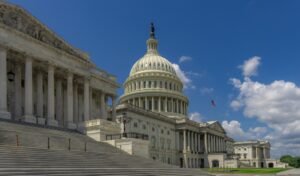
The U.S. Capitol is not part of the National Park Service; it is managed by the Architect of the Capitol and secured by the Capitol Police. This is where most corporate video production in D.C. runs into trouble.
- Tripod Rules: If you are using a tripod on Capitol Grounds (which includes the grassy areas leading up to the building), you must have a permit. Handheld filming for non-commercial use is generally tolerated, but “commercial” is a broad term in the eyes of the USCP.
- The “Union Square” Rule: Traditionally, commercial filming was limited to Union Square (near the Reflecting Pool). However, recent legislative efforts in 2026 have sought to expand commercial access to other parts of the Capitol Complex when Congress is out of session. Always check the latest USCP Special Events guidelines before you scout.
- The Steps are Off-Limits: Do not attempt to film on the actual steps of the Capitol or the House/Senate office buildings. These are strictly for official business and accredited press gallery members.
Federal Agencies and “Visual Identity”
Filming the exterior of a federal building like the Department of Justice or the FBI is generally legal from a public sidewalk. However, once you step onto the building’s plaza or attempt to film the interior, you are in a new realm of security.
If you are working with a federal agency, you will likely need to sign a Multimedia Agreement. This gives the agency “script approval” over how their visual identity (logos, badges, and buildings) is used. Security screenings for your gear should be factored into your production schedule.
A Real-Life Example from Our Crew
Our video production company (DC Corporate Video) recently filmed a series of man on the street interviews at one of DC’s national monuments. We spoke with a security guard who told us that we were allowed to film the interviews as long as we didn’t cross into a specific area. We then spent about 45 minutes recording interviews in the section that was deemed ok to film. Then, a police officer walked up to us and told us that we actually were not allowed to film in any areas if we were using a tripod and that we had to leave. Fortunately, he did not give us a fine, but it certainly was a lesson to always make sure to do research ahead of time to find out all of the laws before filming.
Pro-Tips for a Smooth D.C. Production
To stay ahead of the game, every DC videographer should keep these technical and logistical tips in mind:
- Wireless Interference: D.C. is one of the most “RF-heavy” environments in the world. Between the Secret Service, secure comms, and news crews, your wireless mics will likely drop out. Always have a “hardwired” backup for audio.
- The 30-Day Rule: For complex shoots involving the Metro (WMATA) or large-scale street closures, D.C. agencies typically require at least 30 business days of lead time.
- Parking: Most federal areas have zero street parking for production vans. Any video production companies in Washington, DC should factor in a dedicated “production assistant for parking” or budget for private garages.
Why Hire a Local Video Production Company in D.C.?
Navigating these rules alone can be a nightmare for out-of-town producers. A local video production company in D.C. doesn’t just bring cameras; they bring relationships with permit offices and an intuitive understanding of where the “invisible lines” are drawn.
Whether you need a videographer for a quick interview or a full-scale corporate video production in D.C., understanding the legal landscape is the first step to a masterpiece.